


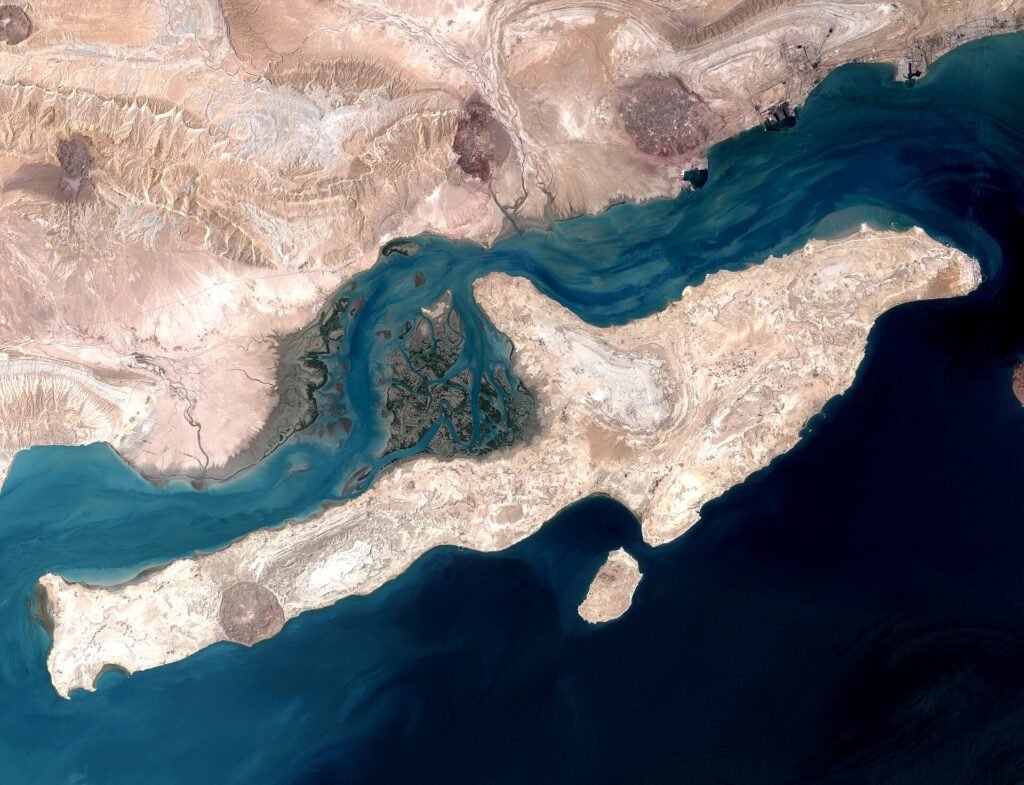
President Donald Trump said on Friday that U.S. forces had carried out a limited strike on an Iranian air defense system near Qeshm Island in the Strait of Hormuz, an action he called “minor,” as Qatar pressed Washington and Tehran to reach a deal to end a war now more than eight months old.
What happened on Qeshm Island
Trump told reporters shortly after arriving in West Palm Beach, Florida, on Friday evening that Iran had set up a small anti-aircraft device and that U.S. forces destroyed it. “We knocked it out in about 15 minutes, maybe five,” he said, according to the Associated Press. Iranian state media reported the sound of two explosions in the Suza area of Qeshm Island, which sits in the strait, a crucial route for global oil shipments.
Iran gave a different account. The state broadcaster IRIB reported an Iranian army statement saying the country’s air defense forces had intercepted and destroyed an American MQ-9 drone over Qeshm Island, Al Jazeera reported. The United States has not confirmed that claim, and U.S. Central Command, which oversees American forces in the Middle East, said the situation was “relatively calm.”
It was the second round of strikes in a week. On Monday, the U.S. military carried out what it described as defensive strikes, and explosions were heard on Qeshm and nearby Hengam Island and in the mainland area of Bandar Abbas, the AP reported. U.S. officials say most of Iran’s air defense systems were destroyed or badly damaged during Israel’s June 2025 bombardment and in the early stages of the current conflict, and that Iran has been working to rebuild them. Friday’s strikes were also the first since Tuesday’s midterm elections, in which Trump’s Republican Party lost both chambers of Congress.
Qatar urges a deal, perfect or not
Qatar’s prime minister and foreign minister, Sheikh Mohammed bin Abdulrahman Al Thani, made the diplomatic push in public on Friday. In an interview at Oxford University, he urged the United States and Iran not to wait for ideal conditions to end the war. “We will never have a perfect peace deal, but you can’t wait for that perfect moment,” he said, according to remarks reported by Bloomberg and cited by Al Jazeera. He warned that the crisis “cannot be left unresolved,” and Qatar dismissed reports that the talks had failed.
Behind the scenes, Iran is weighing concrete proposals. Two Middle East government officials told the AP on Friday that Iran was reviewing proposals presented by Qatar, the chief mediator, aimed at closing the gaps between the two sides over Tehran’s nuclear program. One official stressed that Iran remains unwilling to negotiate over its atomic activities until the United States agrees to several conditions Tehran wants in a ceasefire, among them ending the U.S. blockade of Iran’s ports, lifting sanctions, unfreezing Iranian assets and paying compensation for war damage.
Regional officials outlined a possible two-day bridge deal to the AP. In a first phase, the United States would lift the blockade and release some frozen Iranian funds, and Iran would let International Atomic Energy Agency inspectors back into nuclear sites bombed by the United States and Israel. On the second day, Iran would reopen the Strait of Hormuz under a modified agreement it has reached with Oman but that Washington has not approved. Broader talks on Iran’s stockpile of highly enriched uranium would follow. The White House declined to comment on the proposals.
Washington talks, and warns
Trump sounded upbeat about the contacts. “We are talking to Iran. We have been,” he said on Friday. The Qatari government said Trump and Qatar’s emir also spoke by phone on Friday about efforts to deescalate tensions, and Defense Secretary Pete Hegseth spoke with his Qatari counterpart the same day, according to the AP.
At the same time, Washington raised its guard. The State Department urged Americans across the Middle East to exercise “heightened vigilance,” warning of an increased threat of armed attacks by Iranian-supported Houthis and of Iranian efforts to target U.S. government officials, and it cautioned travelers about possible flight cancellations, airspace closures and other disruptions, Al Jazeera reported. Late on Friday, U.S. Central Command announced that the United States is offering a reward of up to $20 million, and possible relocation, for information about Iran’s nuclear program through the State Department’s Rewards for Justice program.
Follow the latest in our News coverage.
Sources: Associated Press; Al Jazeera; Bloomberg.